

What Is Hydrotalcite?
Hydrotalcite, also known as a Layered Double Hydroxide (LDH), is a family of naturally occurring and synthetic layered materials that have attracted significant attention due to their unique combination of acid scavenging capability, anion exchange capacity, thermal stability, and environmental compatibility. These properties make hydrotalcite an essential functional additive in a wide range of industries, including polymer processing, PVC stabilization, rubber manufacturing, coatings, catalysis, pharmaceuticals, and environmental protection.
Hydrotalcite occurs both as a natural mineral and as a synthetic material. However, synthetic hydrotalcite, particularly nano-sized grades, is preferred for industrial applications because it offers higher purity, controlled composition, uniform particle size distribution, and more consistent performance. Moreover, its heavy-metal-free composition makes it an environmentally friendly alternative to many conventional stabilizing additives, supporting the global transition toward sustainable polymer formulations.
Chemical Structure of Hydrotalcite
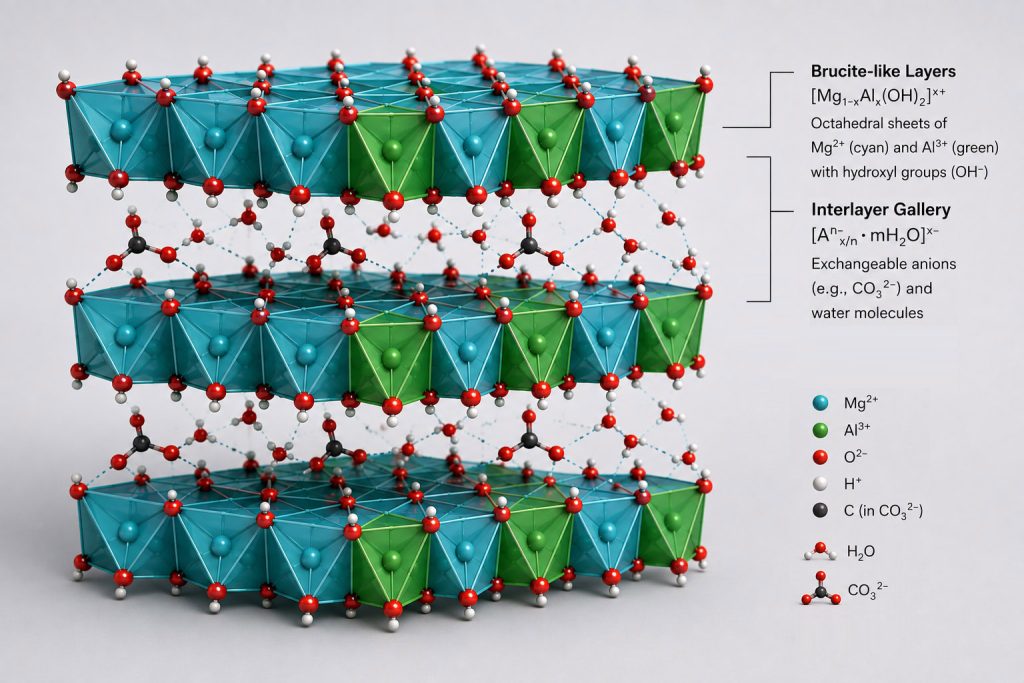
Hydrotalcite possesses a layered crystal structure similar to that of the mineral brucite (Mg(OH)₂). In this structure, a portion of the divalent metal cations (typically magnesium) is substituted by trivalent cations (most commonly aluminum). This substitution creates a net positive charge within the hydroxide layers, which is balanced by interlayer anions together with water molecules.
The chemical formula of the most common magnesium-aluminum hydrotalcite is Mg₆Al₂(OH)₁₆CO₃·4H₂O.
The interlayer galleries may contain various exchangeable anions, including carbonate, sulfate, nitrate, or chloride. This anion exchange capability makes hydrotalcite a highly versatile material that can be tailored for specific industrial applications.
Although magnesium-aluminum hydrotalcite is the most widely used composition, similar layered double hydroxides containing zinc, nickel, copper, manganese, or iron can also be synthesized, each providing distinct physical and chemical characteristics for specialized applications.
Key Properties of Hydrotalcite
Hydrotalcite is much more than a conventional mineral filler. It is considered a multifunctional performance additive with several valuable properties:
- High acid neutralization and acid scavenging capacity
- Excellent thermal stability during polymer processing
- Heavy-metal-free and environmentally friendly composition
- High anion exchange capacity
- Adjustable layered nanostructure
- High specific surface area in nano grades
- Improved dispersion in polymer matrices
- Enhanced long-term thermal stabilization
- Excellent chemical stability
- Compatibility with modern lead-free stabilization systems
These combined characteristics have made hydrotalcite one of the most important functional additives in advanced polymer formulations.
Industrial Applications of Hydrotalcite
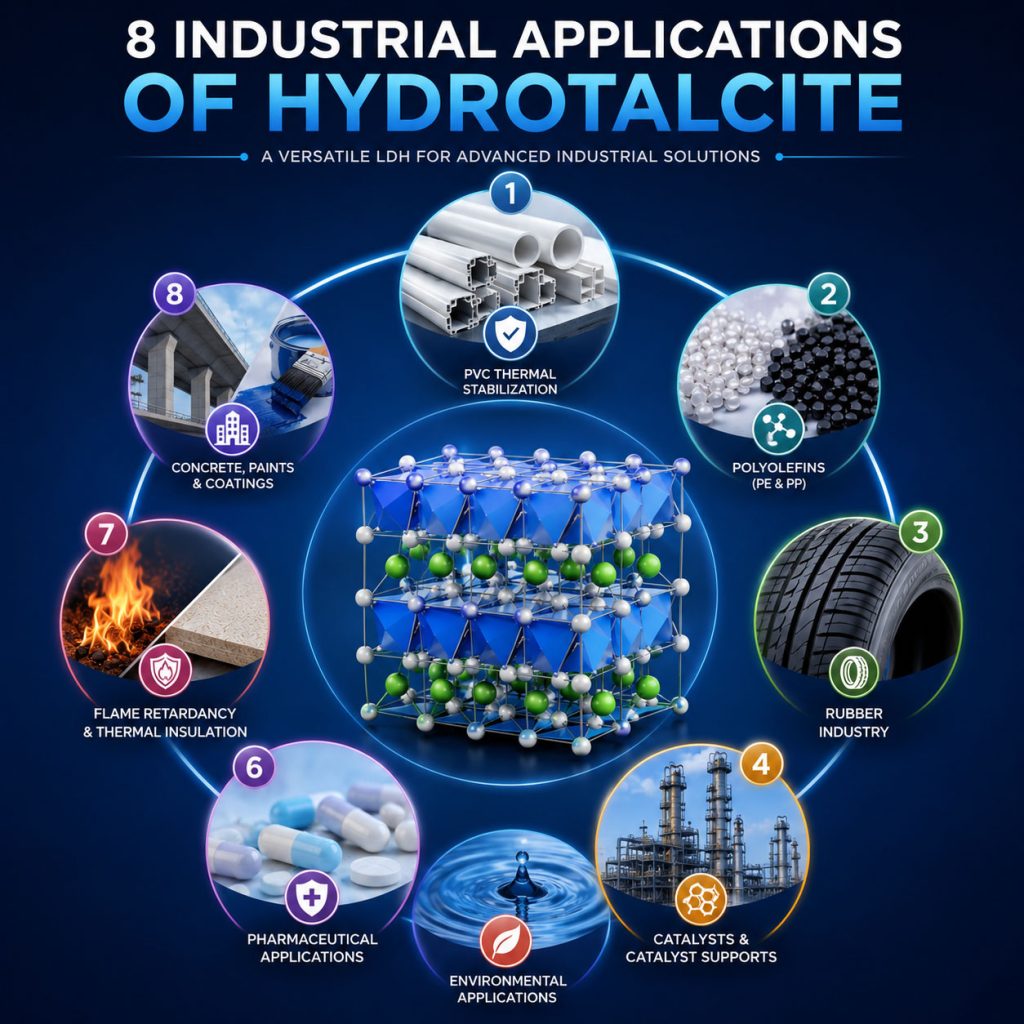
1. PVC Thermal Stabilization
The largest and most important application of hydrotalcite is in polyvinyl chloride (PVC). During PVC processing, hydrogen chloride (HCl) is released as thermal degradation begins. Once generated, HCl accelerates further degradation, resulting in discoloration, molecular chain scission, and deterioration of mechanical properties.
Hydrotalcite functions as an efficient acid scavenger, rapidly neutralizing HCl before it can catalyze additional degradation. It is commonly used in combination with calcium-zinc (Ca-Zn) stabilizers or organotin stabilizer systems, where it significantly improves long-term thermal stability and processing performance.
2. Polyolefins (PE and PP)
In polyethylene (PE) and polypropylene (PP), hydrotalcite absorbs residual acidic catalyst residues and oxidation by-products generated during processing. This improves melt stability, extends processing windows, and contributes to better long-term thermal performance.
3. Rubber Industry
Hydrotalcite is widely used in certain rubber formulations, particularly halogenated elastomers, where it scavenges hydrogen chloride (HCl) and hydrogen bromide (HBr). This helps improve thermal durability, aging resistance, and overall service life of rubber products.
4. Catalysts and Catalyst Supports
Following calcination, hydrotalcite converts into mixed metal oxides possessing excellent catalytic properties. Owing to its unique layered structure and tunable composition, hydrotalcite serves as a catalyst precursor, catalyst support, and adsorbent in numerous petrochemical processes, including methane reforming, biodiesel production, and glycerol conversion.
5. Environmental Applications
The high anion exchange capacity of layered double hydroxides makes hydrotalcite an effective material for environmental remediation. It has been extensively investigated for removing phosphate, heavy metals, and organic dyes from industrial wastewater, as well as for carbon dioxide adsorption and capture.
6. Pharmaceutical Applications
Hydrotalcite has long been used as an antacid to neutralize excess gastric acid. More recently, its layered structure has attracted considerable interest as a controlled drug delivery carrier capable of improving drug stability and sustained release characteristics.
7. Flame Retardancy and Thermal Insulation
Hydrotalcite contributes to flame retardancy by reducing heat release during combustion and promoting the formation of protective inorganic residues. It is increasingly incorporated into polymer masterbatches, cable compounds, and fire-resistant coatings. Emerging applications also include thermal insulation materials used in the construction industry.
8. Concrete, Paints, and Coatings
Recent studies have demonstrated that hydrotalcite can improve the resistance of reinforced concrete to chloride penetration, thereby reducing steel corrosion and extending service life. In paints and coatings, hydrotalcite enhances chemical stability, surface quality, and pH control, contributing to improved coating durability.
Natural versus Synthetic Nano Hydrotalcite
Natural hydrotalcite occurs as a mineral but generally contains impurities and exhibits irregular particle size distribution, limiting its suitability for demanding industrial applications.
In contrast, synthetic nano hydrotalcite offers controlled chemical composition, high purity, uniform crystal structure, and significantly smaller particle size. These characteristics lead to superior dispersion within polymer matrices, greater acid scavenging efficiency, and enhanced thermal stabilization performance.
The development and production of advanced synthetic hydrotalcite grades represent an active area of innovation at Nano Parmin Khavaran, where research focuses on engineering high-performance layered double hydroxides tailored for modern polymer processing.
Frequently Asked Questions (FAQ)
What is hydrotalcite?
Hydrotalcite is a magnesium-aluminum layered double hydroxide (LDH) that may occur naturally or be synthesized. It is widely used as an acid scavenger, thermal stabilizer, anion exchanger, catalyst precursor, and functional additive across numerous industries.
What is the difference between hydrotalcite and nanoclay?
Although both materials possess layered nanostructures, they differ fundamentally. Conventional nanoclays, such as montmorillonite, are negatively charged layered silicates, whereas hydrotalcite is an anion clay consisting of positively charged hydroxide layers with exchangeable interlayer anions. Consequently, their stabilization mechanisms and industrial applications differ significantly.
Why is hydrotalcite used in PVC?
Hydrotalcite efficiently captures hydrogen chloride released during PVC processing, interrupting the autocatalytic degradation cycle. This significantly improves thermal stability, minimizes discoloration, and extends the service life of PVC products.
Is hydrotalcite environmentally safe?
Yes. Hydrotalcite contains no heavy metals and is considered an environmentally friendly alternative to many traditional stabilizers. Its excellent safety profile has contributed to its increasing adoption in lead-free polymer formulations.
